

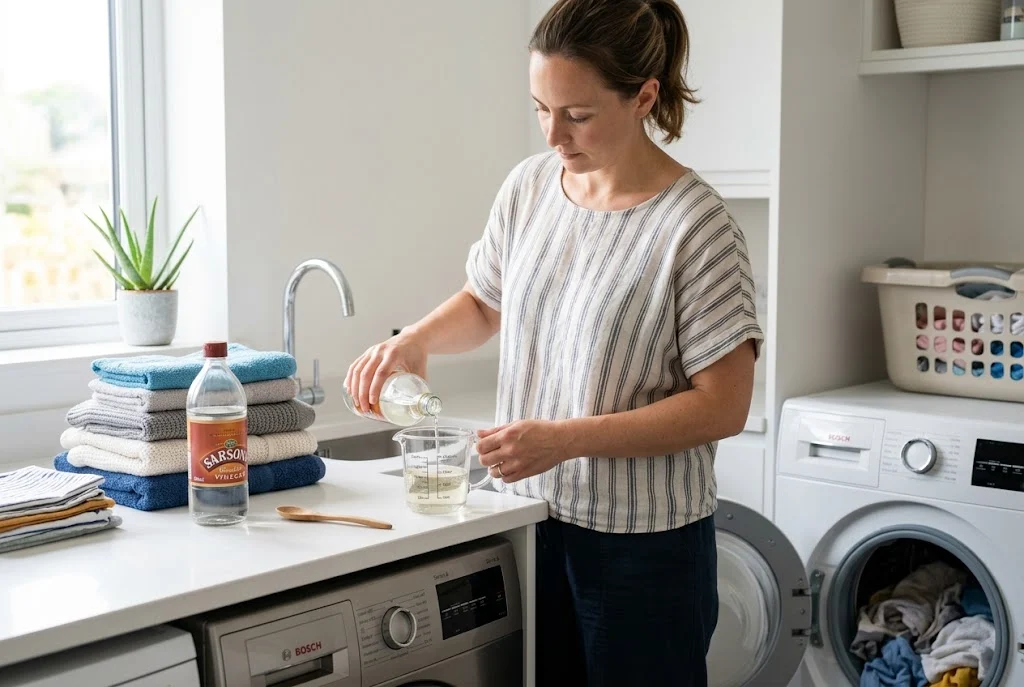
Learning how to wash clothes in vinegar can be useful when you want to deal with certain laundry odours, detergent residue or hard-water-related buildup. White vinegar is acidic, so it can help with some laundry problems, but it should not be treated as a replacement for laundry detergent or as a universal solution for every fabric.
Used correctly, vinegar can have a place in a sensible laundry routine. The important points are choosing plain white vinegar, using an appropriate amount, following garment care instructions and avoiding combinations that could create a dangerous reaction. This guide explains how to use vinegar with laundry, when it may help and what mistakes to avoid.
What Does Vinegar Do for Clothes?
Vinegar contains acetic acid, which gives it its acidic properties. In laundry, that can make it useful for certain problems involving detergent residue, hard-water minerals and some unpleasant smells.
The American Cleaning Institute notes that vinegar can be helpful in laundry for problems such as certain detergent-related stains and the effects of hard water. It also stresses that vinegar is not suitable for every cleaning situation and that manufacturers’ instructions should be followed. The American Cleaning Institute’s guidance on cleaning with vinegar provides further information about its appropriate uses.
However, vinegar is not a substitute for a proper laundry detergent when your main objective is removing body oils, dirt and everyday soil. Detergent is specifically formulated for laundry and should remain the main cleaning product for a normal wash.
How to Wash Clothes in Vinegar Safely
If you want to use vinegar as part of your laundry routine, start by checking the clothing care label. Make sure the garment can be washed using the intended method and avoid experimenting with valuable or specialist fabrics unless their care instructions allow it.
For routine laundry, vinegar is generally best treated as an occasional laundry aid rather than the main washing product. You can use it in appropriate situations alongside normal laundry practices, while following the instructions for your washing machine and detergent.
1. Choose Plain White Vinegar
Use plain white vinegar rather than a coloured, flavoured or specially formulated vinegar intended for cooking. You want a simple product without unnecessary ingredients that could affect clothing.
Check the bottle before using it and avoid products containing added colourants, fragrances or other ingredients that are not intended for laundry use.
2. Check the Clothing Care Label
Before using vinegar on a garment, check its care instructions. Different fibres can react differently to cleaning products, so there is no single laundry treatment that is appropriate for every item.
If the manufacturer recommends a specialist cleaning method, follow those instructions instead of assuming vinegar is safe.
3. Use Vinegar for the Right Laundry Problem
Vinegar may be useful when you are dealing with certain detergent residues, hard-water effects or particular odour problems. It should not be used simply because a larger quantity seems likely to produce a stronger cleaning effect.
For example, the American Cleaning Institute provides specific vinegar-based soaking methods for some detergent residue and hard-water-related laundry problems. The recommended approach varies according to the particular problem, which is why identifying the issue first is important.
4. Dilute Vinegar When the Method Requires It
Some laundry treatments involving vinegar use a diluted solution rather than applying concentrated vinegar directly to clothing. Dilution can make the treatment more appropriate for the particular laundry problem.
For example, the American Cleaning Institute recommends a diluted white-vinegar solution for certain blue detergent stains and residue-related problems. Its guidance uses specific proportions and soaking instructions rather than recommending undiluted vinegar for every situation.
This is an important distinction: do not assume that more vinegar means better cleaning.
How to Use Vinegar to Wash Clothes in a Washing Machine
If you are using a washing machine, always follow the machine manufacturer’s instructions as well as the instructions on your detergent and any laundry product you use.
Vinegar should not be added randomly to every part of the machine. If you intend to use it for a particular laundry purpose, use the method appropriate for that purpose and avoid mixing it directly with incompatible cleaning products.
For everyday laundry, start with a suitable detergent and the correct wash programme. Vinegar should only have a supporting role when there is a specific reason to use it.
If you want to improve your overall laundry routine, our guide to how to wash clothes in a washer covers the basic process of sorting garments, choosing settings and washing clothes correctly.
Can Vinegar Help Remove Laundry Odours?
Vinegar is sometimes used as a laundry aid when clothes have an unpleasant or musty smell. Its acidic properties can help with certain residues and odour-related problems, although it should not be regarded as a guaranteed solution for every source of bad smells.
If clothes repeatedly smell damp after washing, look at the entire laundry process rather than simply adding more vinegar. Clothes need to be washed appropriately, rinsed thoroughly and dried properly.
Wet laundry should not be left sitting for long periods. Once the wash is finished, move clothing to the drying stage and provide enough airflow for moisture to escape.
If your main goal is consistently fresh-smelling laundry, you can also read our guide on how to make laundry smell good for broader laundry freshness tips.
Using Vinegar to Clean Clothes by Hand
You can also encounter situations where vinegar is used as part of a handwashing or soaking treatment. However, the same principles apply: check the garment’s care label, use an appropriate dilution when recommended and rinse clothing thoroughly afterwards.
Vinegar should not replace suitable laundry detergent when you are trying to remove ordinary dirt and body oils. Instead, consider whether vinegar addresses the specific laundry problem you are experiencing.
For garments that require gentle manual cleaning, our guide to how to hand wash clothes explains how to sort, soak, gently agitate, rinse and dry clothing without unnecessary friction.
Vinegar and Hard Water Laundry Problems
Hard water contains minerals that can interact with some laundry products. Over time, this can contribute to residue and affect how fabrics feel after washing.
Vinegar can be useful in certain hard-water-related laundry situations because its acidity can interact with mineral deposits. The American Cleaning Institute specifically identifies vinegar as a possible solution for some problems associated with hard water and detergent residue.
However, if you regularly experience laundry problems caused by hard water, adding increasing amounts of vinegar is not necessarily the best long-term answer. Consider the detergent you use, the water conditions in your area and the washing instructions for your clothing.
Can You Use Vinegar Instead of Laundry Detergent?
Generally, vinegar should not be considered a direct replacement for laundry detergent. Laundry detergent is formulated to remove soils such as body oils, grease and everyday dirt from fabrics.
Vinegar has different chemical properties and is useful for different types of cleaning problems. Using it alone may therefore leave clothes insufficiently cleaned, particularly when garments are visibly dirty or have absorbed body oils.
A better approach is to use a suitable laundry detergent for normal washing and consider vinegar only when there is a specific, appropriate reason to use it.
Can You Mix Vinegar With Other Laundry Products?
Do not mix vinegar with chlorine bleach. Combining an acid such as vinegar with chlorine bleach can produce dangerous chlorine gas.
This is one of the most important safety rules when using vinegar for cleaning. Keep vinegar separate from bleach and follow the instructions on every cleaning product you use.
You should also avoid creating your own mixtures of multiple cleaning products simply because they are individually suitable for laundry. More cleaning products do not automatically mean better results.
What Clothes Should You Be Careful With?
Not every fabric should be treated in exactly the same way. Delicate garments, specialist materials and clothing with unusual finishes may have specific care requirements.
Always check the care label before introducing vinegar into your laundry routine. If the manufacturer does not recommend the treatment, choose a safer method that follows the garment’s instructions.
It is also sensible to be cautious with valuable clothing. If you are uncertain whether a particular fabric will tolerate an acidic treatment, professional cleaning may be a better option than experimenting at home.
Common Mistakes When Using Vinegar for Laundry
Using too much vinegar is one of the most common mistakes. A stronger-smelling solution does not necessarily clean clothes more effectively.
Another mistake is assuming vinegar can replace every laundry product. Detergent and vinegar have different purposes, so using one as a universal substitute for the other can produce disappointing results.
Applying vinegar without checking the care label is another unnecessary risk. Garment manufacturers provide washing instructions for a reason, particularly for delicate or specialist fabrics.
Finally, never mix vinegar with chlorine bleach. Keep cleaning products separate and use them only according to their instructions.
How to Get Better Results From Vinegar in Laundry
The best approach is to treat vinegar as a targeted laundry aid rather than a miracle cleaning solution. First identify the problem. Is there detergent residue? A hard-water issue? A particular odour? Once you understand the problem, you can decide whether vinegar is an appropriate treatment.
Use the smallest suitable amount for the recommended method and rinse garments properly. Avoid unnecessary soaking, excessive quantities and improvised mixtures.
It is also worth maintaining good general laundry habits. Sort clothes appropriately, use the correct detergent, select a suitable washing programme and dry garments thoroughly after washing.
When Vinegar Is Not the Right Choice
There are situations where a specialist laundry product or professional cleaning service is more appropriate. Heavily stained clothing, specialist fabrics and garments with strict care requirements may need a different treatment.
Vinegar also should not be considered a disinfectant. The American Cleaning Institute specifically notes that vinegar is not a disinfectant and should not be treated as an equivalent to a registered disinfecting product.
If you are unsure how to treat a particular garment, follow the care label or seek professional advice rather than experimenting with household cleaning mixtures.
Final Tips for Using Vinegar With Laundry
- Use plain white vinegar when a vinegar laundry treatment is appropriate.
- Always check the garment care label first.
- Use vinegar for specific laundry problems rather than as a universal cleaner.
- Follow recommended dilution and soaking instructions carefully.
- Do not assume that using more vinegar will produce better results.
- Use normal laundry detergent for everyday dirt and body oils.
- Rinse clothing thoroughly when a vinegar treatment requires rinsing.
- Never mix vinegar with chlorine bleach.
- Be especially cautious with delicate or specialist fabrics.
- Consider professional cleaning when a garment has specialist care requirements.
Understanding how to wash clothes in vinegar is really about knowing when vinegar is useful and when it is not. Used appropriately, white vinegar can help with certain laundry problems, including some detergent residue and hard-water-related issues. However, it works best as part of a sensible laundry routine rather than as a replacement for proper detergent and garment care.
